Copyright exists from the moment a work is created. You do not apply for it, and in the countries signed up to the Berne Convention, which is most of the world, protection cannot be made conditional on any formality at all. Article 5(2) of the Convention puts it directly: the enjoyment and exercise of these rights shall not be subject to any formality.
So the question creators ask, whether they need to do something to own their work, has a clear answer. They don’t.
The question that actually causes trouble is different, and nobody asks it until they’re already in the situation. When someone else claims your work, or a platform holds your upload, or a client uses images past the licence, what can you show?
Owning something and being able to demonstrate that you own it are separate problems. The first is settled by law. The second is settled by whatever records happen to exist, and most creators find out what theirs are worth at the point they need them.
Where the presumption starts
There is a useful starting point built into the same convention. Article 15(1) provides that for a person’s name appearing on a work in the usual manner, that person is regarded as the author in the absence of proof to the contrary, and can bring infringement proceedings on that basis.
A credit line, in other words, does real work. It is a presumption rather than a guarantee, and the phrase in the absence of proof to the contrary is doing the load-bearing here, but it means the starting position is better than most creators assume.
What it doesn’t survive is a genuine dispute. When two people both have their name on versions of the same work, or when a name has been stripped somewhere along the way, the presumption stops helping and the question becomes what each side can actually produce.
The three things creators usually reach for
Ask a room of working creators what they would show if their work was taken, and you get three answers. They aren’t equivalent, and the difference between them isn’t about how convincing they feel.
A file’s timestamp. Created by your computer and controlled by your computer. It changes when you restore from a backup, migrate machines, or export a file again. It also records when a file was last written rather than when the work was made, so something you made in 2023 and re-exported last month reads as last month. The record and the person relying on it are the same party, which is the structural problem no amount of care fixes.
A public post. Stronger, because a third party recorded when the work appeared. That is a real difference and it is why publication dates carry weight. What it establishes is narrower than people expect: that a version of the work was visible on a platform on a date. It says nothing about who made it, nothing about who owns it, and nothing about the material you did not post. It’s also a disclosure, which rules it out entirely for unreleased work, and it depends on a platform that edits, migrates and deletes on its own schedule.
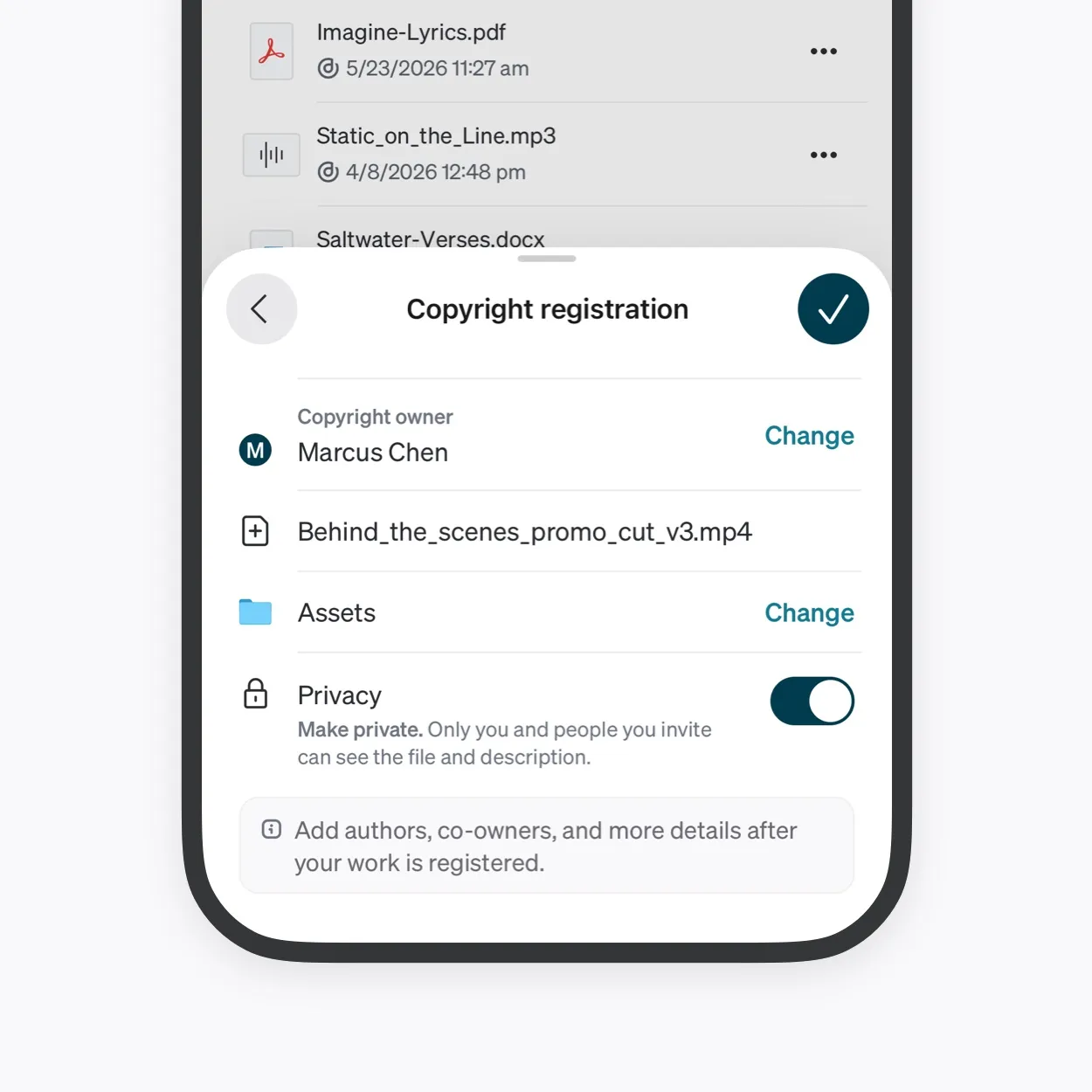
A registration. The date is held by a register rather than by you. It records who authored the work and who owns it, not only that the work existed. And it requires no publication, so unreleased material can go on record without going public.
The distinction underneath all three is custody. Your own machine is the weakest possible custodian of a date about your own work, precisely because it is yours. A platform is better and incidental, since establishing your ownership was never its purpose. A register exists to do this and nothing else.
Why mailing yourself a copy has never worked
The most persistent version of the self-custody problem deserves naming, because it still circulates in forums, comment sections and art schools.
Poor man’s copyright is the practice of posting yourself a sealed copy of your work and keeping the envelope unopened, on the theory that the postmark establishes the date. The United States Copyright Office addresses it directly in its published FAQ: the practice of sending a copy of your own work to yourself is sometimes called a poor man’s copyright, there is no provision in the copyright law regarding any such type of protection, and it is not a substitute for registration.
The email version has the same shape. Your account, your file, your send, and a date recorded by a system you have some ability to influence. A postmark is at least applied by someone else, which makes the posted version marginally stronger than the emailed one, and neither addresses the question of who made the thing inside the envelope.
None of this makes these records worthless. They are corroboration, which is a real role. It’s simply a different role from the one people ask them to perform.
What a registration adds, and what it does not
A registration records that a work existed in a particular form, under a particular owner, with particular authors, on a particular date. The date comes from the register rather than from you.
It doesn’t establish when you created the work. If you made something in 2019 and registered it in 2026, the record says 2026, and nothing about registering later reaches back. It doesn’t rule out that someone else made a similar thing earlier and never registered it. And it isn’t a substitute for legal advice about what any of it means in a specific dispute, which depends on the jurisdiction and on what is actually being argued.
What it gives you is the earlier fixed point, held by a third party, describing more than a date. In a situation where the alternative is two people describing their own recollections, that is the difference between a discussion and an argument.
Why the gap between making and registering matters
Everything above argues for one practical conclusion, which is closing the distance between finishing something and putting it on record.
A work registered the week it was made carries a date close to when it actually existed. The same work registered three years later, after a problem surfaced, carries a date that says as much about when you became concerned as about when you created anything.
This is the entire case for registering on a routine rather than in response to something. Not because a late record is useless, but because an early one is straightforwardly better and costs exactly the same.
What to do about it
If you’re reading this because something has already happened, register the work now and gather everything else you have: working files, dated correspondence, briefs, delivery emails, publication history. Then talk to a lawyer, with the material assembled rather than in the abstract.
If nothing has happened, the useful move is smaller. Look at what you finished this month and put the pieces that matter on record. Then do it again next month.
The records that help are the ones that already existed before anyone needed them. That’s the whole of it.