The credit on a finished piece usually names one person. The making of it rarely involved one.
Ownership is normally settled and uncontroversial, since the artist owns the work. What is less settled is whether anyone else who shaped it is recorded anywhere that will still exist in ten years. Most studios handle that by not recording it at all.
Fabricators, assistants, printers and technicians turn up in the account of how a piece was made and then disappear from the paperwork, and the reason is usually a misunderstanding about what crediting someone costs.
Ownership and credit are separate fields
A registration has an owners list and an authors list, and they do different jobs.
Owners are the parties holding rights in the work. In a studio practice that is normally the artist, or the artist’s company.
Authors are the people credited with creating it. That list can include people who own nothing, which is exactly the arrangement most studios operate under: a fabricator contributed real skill to a work they have no claim over.
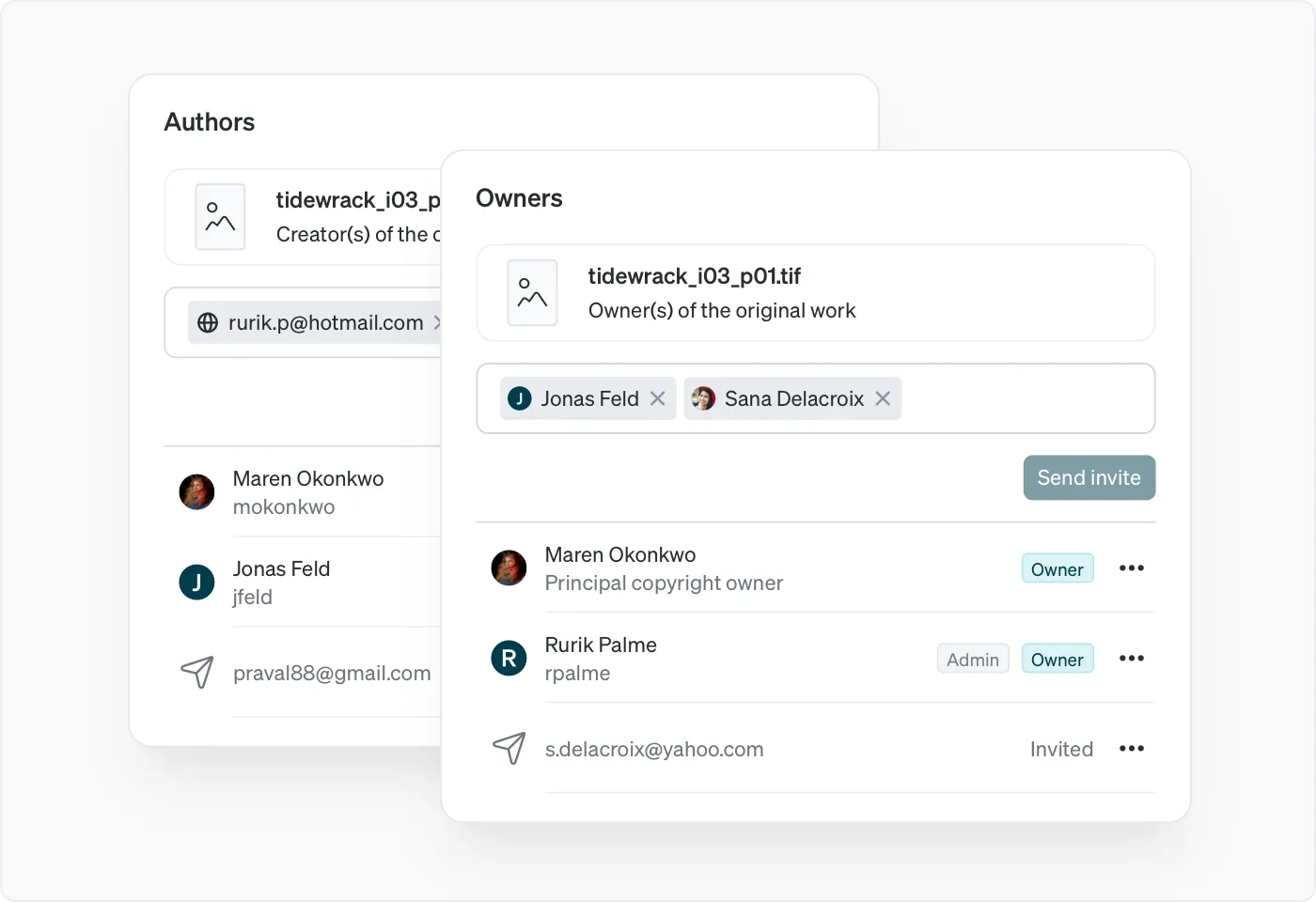
So crediting someone as an author doesn’t give them ownership, and it doesn’t dilute yours. It records that they were involved.
That separation runs deeper than any one system. Article 6bis of the Berne Convention provides that independently of the author’s economic rights, and even after the transfer of the said rights, the author shall have the right to claim authorship of the work. Attribution and ownership have been treated as distinct in international copyright since 1928.
Why bother, when nobody is disputing anything
Three reasons, and none of them is a dispute.
Provenance. Institutions, galleries and auction houses ask who made a work, and for anything fabricated the honest answer involves more than one name. A record made at the time is better than a recollection assembled for a condition report fifteen years later.
Practice. A studio that credits the people in it retains them longer, and fabricators talk to each other about who does. This costs nothing and is noticed.
Accuracy. If your work is ever examined closely, an account that matches how it was actually made is a stronger position than one that quietly implies you did everything alone.
Who goes on the list
People whose contribution shaped the work as it exists. A fabricator who engineered a piece. A studio assistant who painted areas under direction. A printer who pulled an edition. A specialist who did casting, welding, glazing, framing where the framing is part of the piece.
People who didn’t shape the work generally don’t belong there. A studio manager, a photographer documenting the finished piece, someone who crated it.
The author list records who was involved. Your own credit line, condition report or catalogue entry is where the specific roles belong, and the registration is what stops that list being reconstructed from memory.
Add them when you know, not when you register
Authors can be added at any time, so the list doesn’t have to be complete on the day. A specialist brought in at the end can go on afterward.
The principal owner is the one to be certain about at the point of registering, since that can’t be edited later.
In practice the easiest habit is to register a work when it is finished and add contributors while the studio still remembers, which is usually the same week rather than the same afternoon.
Where someone might actually have a claim
Occasionally a contribution is creative enough that ownership is a real question rather than a courtesy, and the usual case is a collaborator rather than a fabricator working to your specification.
That is decided by what was agreed and by the law where you’re, not by what a registration says. If the question is live on a valuable work, resolve it with a lawyer before the work is exhibited or sold, and registering under the ownership everyone actually agrees on.
Where the agreement is clear that you own it, register accordingly and credit generously. The two aren’t in tension.
Telling people you have done it
Mention it to the people involved, because being credited is only useful to someone who knows about it.
A short note when a piece is finished, saying who is on the record for it, costs a minute and is the part fabricators and assistants actually remember.