Why Your Songs, Scripts, And Images Belong Next To Gold, Cash, And Bitcoin
When markets get shaky, people fall back on habits.
Some run to gold. Some pile into cash. Some invest in bitcoin or whatever the next coin of the week is. Everyone looks for something that will hold its value if the rest of the world goes sideways.
There is another asset quietly doing that job that almost never gets mentioned in the same breath: copyright.
Every time someone presses play on a song, streams a show, downloads an ebook, buys a game, licenses a photo, or feeds material into an AI tool, there is a rights transaction happening. Sometimes it is explicit. Often it is buried inside a platform or a contract.
We are used to thinking of copyright as a legal technicality or a notice on a contract.
In a digital economy, that view is much too small. Copyright behaves more like a form of currency where it stores value and can survive economic swings. It can be traded, sliced, packaged, and used to generate long term income.
If you are not treating it that way, someone else is, and they are building their balance sheet on top of what you created.
What Does It Even Mean To Call Copyright A Currency?
Economists usually say money does three things: it is a medium of exchange, a store of value, and a unit of account. Copyright is not money in the strict sense, but it ticks enough of these boxes to be taken seriously.
When you write a song, produce a film, code a game, design a character, or publish a book, you have created something that:
- can hold value over time,
- can be exchanged for money through licensing and use, and
- can be counted, priced, and traded in catalogs and deals.
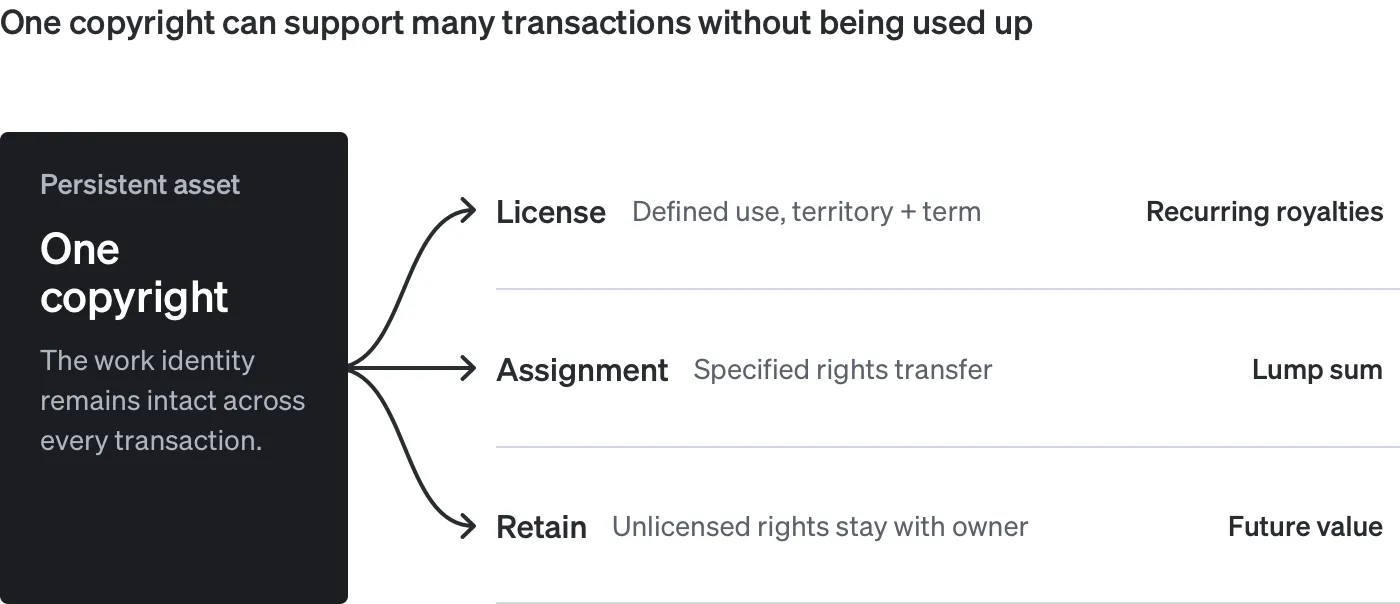
Unlike a bar of gold, copyright is not physically scarce. A single song can be streamed millions of times without wearing out. Unlike cash, it is not automatically eaten alive by inflation just by existing in an account. Unlike bitcoin, its value is not purely speculative. It is tethered to something concrete: human attention and the demand for stories, sound, images, and ideas.
As long as people want those things, a well managed copyright portfolio can survive a lot of market noise.
That does not mean every song or script is an asset that will appreciate. It does mean that thinking about copyright as a kind of currency is more accurate than treating it as a background legal detail.
Gold, Cash, Bitcoin, Catalogs
It helps to make the comparison very literal.
Gold is the classic safe haven. It is tangible and nobody’s central bank can just print more overnight. But gold just sits there. It does not do anything by itself. Your return depends almost entirely on whether others decide it is more valuable later.
Cash is liquid and simple. It lets you move fast. It is also guaranteed to lose purchasing power over time in any normal inflation environment.
Bitcoin and similar assets are volatile instruments that live on sentiment, regulation news, and speculative flows. They can go up violently and down just as fast.
Now think about a strong catalog of copyrights: songs, films, books, games, or image libraries.
- It can be licensed again and again without being used up.
- It can be bundled, carved into pieces, and sold or securitized.
- It often earns a stream of income that is not directly correlated with stock indices or interest rates.
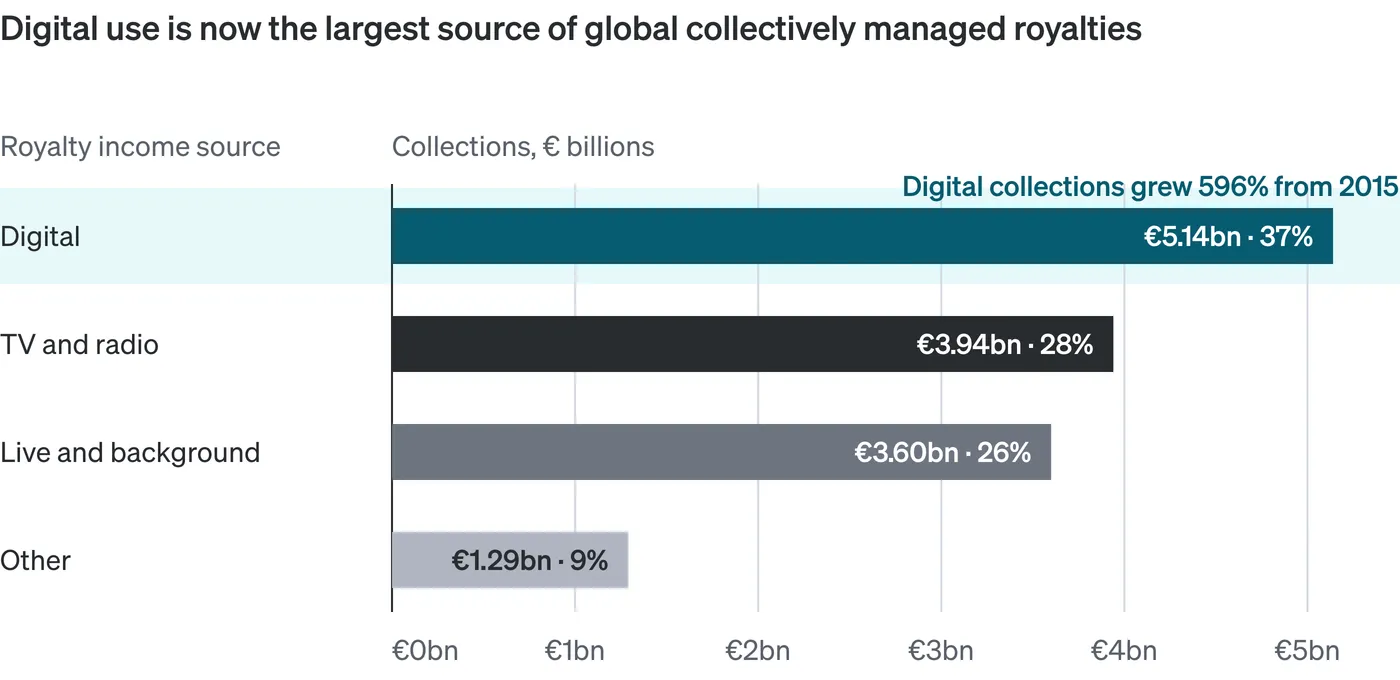
That is why you see private equity and large companies spending billions buying the rights to older music catalogs and film libraries. They are not doing it because they like the artists more than you do. They are doing it because these catalogs behave like income generating assets that can ride out many kinds of economic storms.
The difference is that, for a lot of individual creators and smaller companies, their own copyright still sits like loose change in a drawer. It’s there. It has value. It’s just not being treated like an asset class.
Why Copyright Often Outlives Economic Cycles
When economies tighten, people cut spending on some things, but they almost never stop consuming culture. In plenty of downturns, entertainment spending holds up better than many other categories.
People still watch shows when they are worried about their jobs. Sometimes they watch more. They still listen to music, scroll social feeds, play games, and look for stories that let them escape for a brief moment.
If you own copyrights, this matters.
A film catalog with decent licensing deals can keep generating revenue through multiple recessions. A body of songs can keep earning performance and mechanical income long after its original release window. Well placed stock images and designs stay in circulation across campaigns and markets you will never personally see.
On top of that, copyright is naturally global in a way that a lot of assets are not. A song recorded in Lagos or Kingston can quietly be earning from listeners in cities all over the world. A book originally released in Spanish or Korean can find new life in translation. A character design can end up in games, merchandise, and adaptations far from its original home.
This global reach acts like a built in geographic hedge. When one region slows down, another might be discovering or rediscovering your work. Very few asset classes give solo creators or small companies that kind of exposure.
Nothing about this is automatic. Copyright only behaves as a resilient asset if you actually treat it like one. That means registering it, tracking it, and having some way of connecting it to the markets that want to use it.
The Missing Bank For This Currency
Now imagine a country with a national currency but almost no functioning financial system.
No reliable banks. No payment rails. No good records.
Value would exist, but it would slosh around informally. People would hide cash, store it under mattresses, settle things in cash or barter. The state would have very little visibility into what is happening. A few informal intermediaries would end up controlling a lot of the flows.
That is not far from how copyright behaves today in many places.
Artists and companies create enormous value in the form of songs, scripts, software, films, illustrations, photographs, games. Their “currency” is stored in those works. But the infrastructure around that currency is thin.
Registries are slow or confusing. Many works are never registered. Licensing is often done in private spreadsheets or email threads. Enforcement is mostly a luxury for those who can afford lawyers.
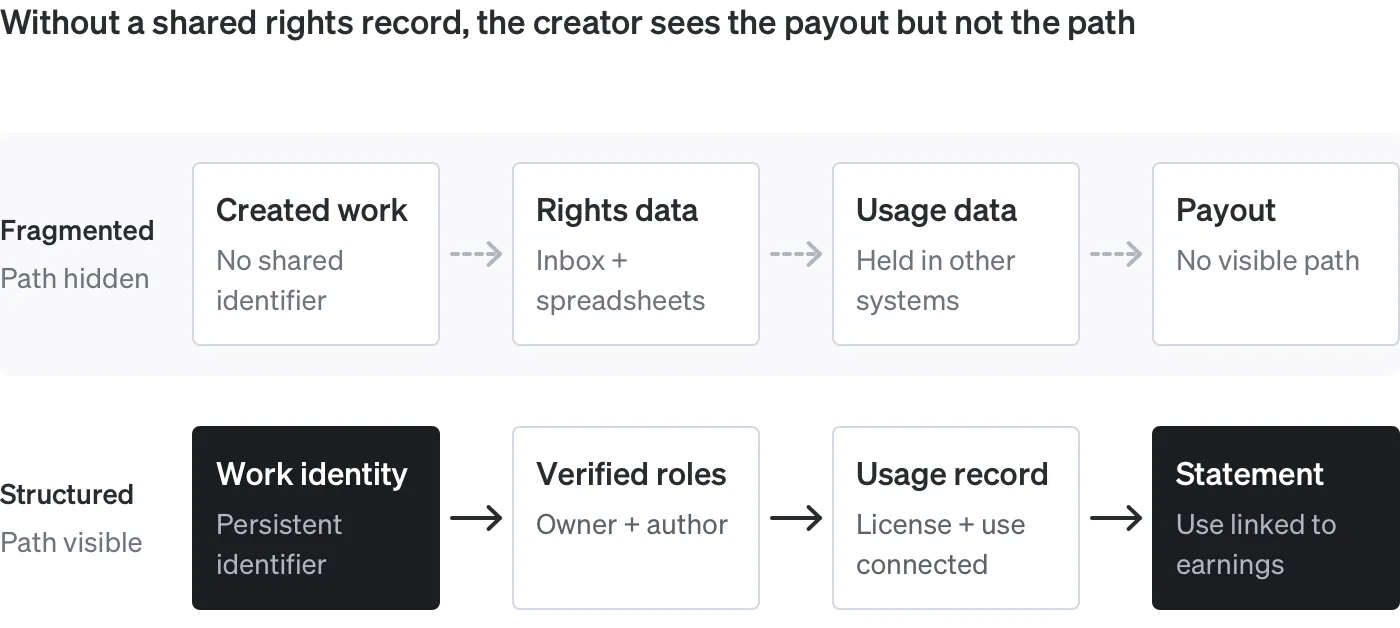
Into that vacuum step platforms, labels, publishers, and tech companies. They become the practical banks and exchanges. They know who is listening, watching, reading. They know where the money is flowing. They decide what gets surfaced.
That is not inherently evil. They provide real value. But there is a power imbalance. The people who made the underlying “currency” often see only the final trickle that reaches them, not the whole river.
Dacr is a response to that gap. It is an attempt to build a modern bank and payment network for this specific currency.
By turning registration and fingerprinting into a quick, digital process, Dacr creates a clear ledger of works and owners. By linking that ledger to licensing and enforcement tools, it gives those entries a way to earn.
On a national level, when governments decide to recognize or integrate with Dacr, they are essentially saying: copyright is part of our economic base, and we want proper institutions around it.
Copyright As A Reserve Asset For Countries
This analogy scales up.
Countries hold reserves in foreign currencies, gold, and sometimes other assets. It is part of how they manage risk and steady their economies.
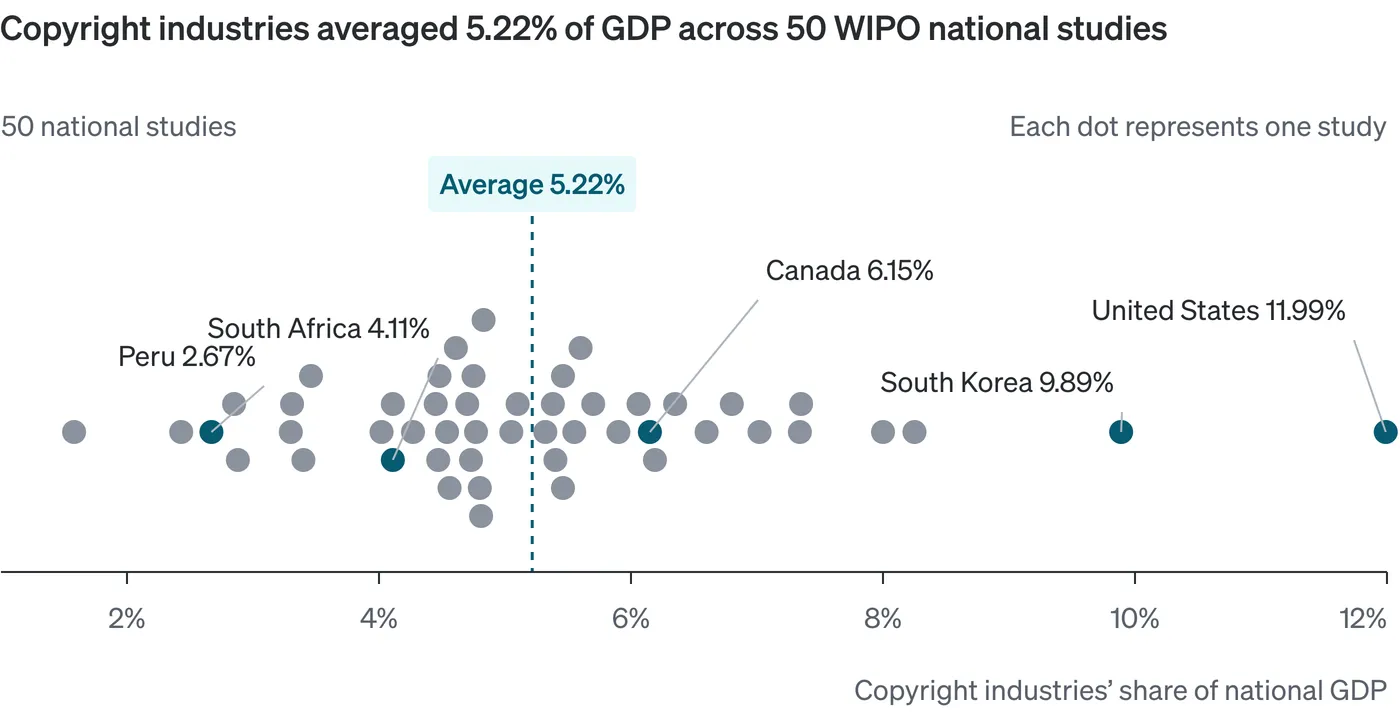
They also hold a less visible reserve: their cultural and intellectual output.
That reserve is not in vaults. It is in studios, laptops, small production companies, indie labels, writers’ rooms, and living rooms. It is in software projects, memes that grow into brands, local shows that later sell formats abroad.
Handled properly, this reserve can generate steady inflows of income and tax for years.
To unlock that, two things have to happen.
First, citizens and companies need to see their works as assets, not just “content.” That means registering them, attaching reliable ownership data, and paying attention to how they are used.
Second, there needs to be infrastructure that can carry that information beyond local borders. Without it, foreign use of domestic works looks like a blur. Payments are sporadic, hard to trace, or never arrive.
Dacr gives countries a way to formalize this reserve. When a government treats Dacr as part of its official copyright system, every registration and recognition event is not just a paperwork step. It becomes a data point in a national ledger of IP.
Cross border recognition fees, domestic registration taxes, and licensing flows can be tied to that ledger. Over time, you get something like a balance sheet of national creativity instead of a pile of anecdotes.
The Hard Question: Who Is Spending Your Currency?
Here is a question that is uncomfortable for almost everyone in this ecosystem.
If copyright behaves like a currency, who is spending it?
Right now, a big part of the answer is: platforms, intermediaries, and more recently, AI companies.
They spend it every time they ingest, host, recommend, remix, or train on creative works. Sometimes they pay for the privilege. Sometimes they do not. Often they have more information about the value of those uses than the creators or even the state.
This is not a conspiracy. It is what happens when one group has the infrastructure and the data, and the others do not.
Treating copyright as a currency flips the question around. It suggests that creators should think in terms of portfolios and rights, not just individual releases. It suggests that governments should look at national IP as a strategic resource, not just a cultural talking point.
And it suggests that, like any serious currency, there should be institutions dedicated to tracking, protecting, and enabling its use.
That is the role Dacr is trying to play.
From Metaphor To Action
Calling copyright a currency is more than a fun metaphor. It’s a prompt.
If you are a creator or a rights-owning company, it should prompt you to ask:
- What exactly do I own and where is it properly registered?
- Can I prove that in a way that will convince a platform or a court?
- Are there markets for my work that I am ignoring because I do not have a way to manage them?
If you are in government, it should prompt questions like:
- How much of our national creative output lives in modern, interoperable rights systems?
- How visible is our IP to potential licensees abroad?
- How much revenue are we likely losing simply because we do not see what is being used?
If you are building platforms or AI, it should prompt an even more pragmatic question:
- What is our plan for a world where rights data is not a blur, but a structured ledger that regulators and partners can look at?
None of these questions are comfortable, but they are all better than guessing.
Dacr will not magically make every song, script, or design valuable. It cannot guarantee that every government will design perfect policies. What it can do is give copyright the basic tools every currency needs: a ledger, a way to move, and institutions that take it seriously.
Markets will keep swinging. Gold will glint. Cash will erode. Crypto will spike and crash. And through all of that, people will still be pressing play, watching, reading, and sharing.
Where there is attention, there is value. Where that value rests on creative work, copyright is in the room whether anyone likes it or not.
The question is whether we keep treating it like a footnote, or finally let it grow into the asset class it already behaves like.