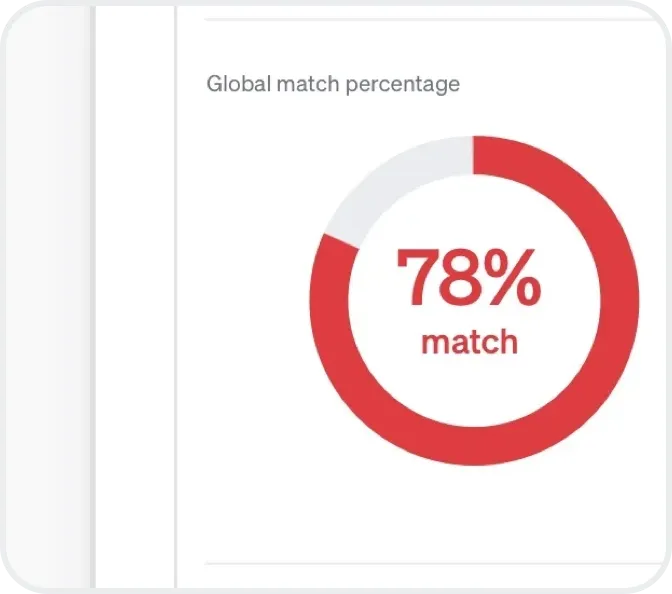
Your report opens on a number. It’s labelled Global match percentage, and the temptation is to read it as a similarity figure, how alike the two files are, expressed as a percentage.
It’s doing more than that, and knowing what it weighs changes what you do about it.
What the score is weighing
The tooltip on that number says it’s a weighted score reflecting both the severity of the detected matches and how much of your registered work was found to match.
Two things follow. It isn’t a plain measure of resemblance between two files. A serious match on a distinctive passage counts for more than a loose one across a lot of material. And the coverage half is measured against your registered work rather than against whatever the other file is, so a long infringing work doesn’t dilute the number the way you might expect.
The bands the score drives
The number sorts a report into three levels. Below 50 is Minimal. Between 50 and 74 is Moderate. At 75 and above it’s Significant.
So a 75 isn’t a middling result. It’s the bottom of the top band. Worth knowing before you decide something at 76 and something at 94 belong in different conversations.
A low score isn’t an all-clear
This is the part most people get backwards, and the product says it plainly: a Minimal rating doesn’t necessarily exclude the presence of isolated sections with stronger similarities.
A weighted, coverage-sensitive score can stay low while containing one match that matters enormously. An eight-bar phrase that happens to be the commercially valuable part of a track, a single frame sequence, a paragraph that took a week to write. The overall figure is doing an average across your work. The thing you care about might be a small part of it.
So read the matches, not just the headline. A low number is a reason to look closely rather than a reason to stop.
The count is a different measurement
Alongside the percentage, the report shows a count labelled Potential infringements. The total potential infringement matches found between the two works. Each one pairs a segment of your registered work with a segment of the other file.
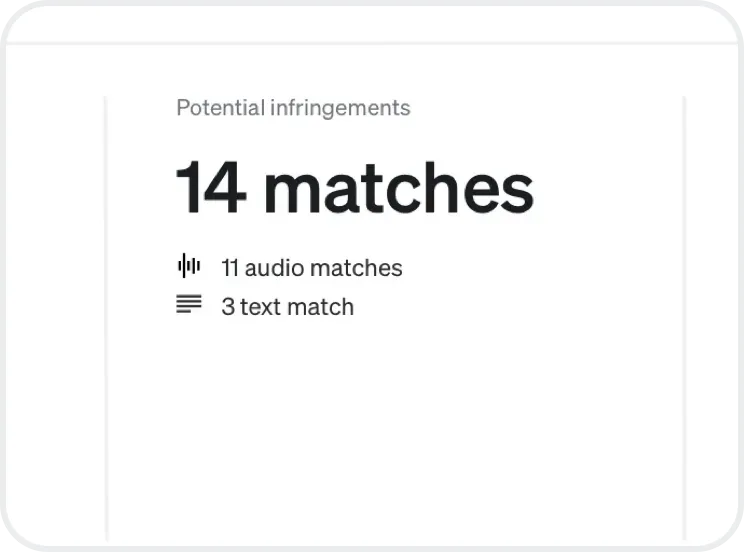
One thing to know if you’ve shared the report: the count reflects only visible matches. An owner can hide individual matches, and hidden ones are excluded for invited viewers as well as for anyone with the public link. A shared report’s count can legitimately differ from what the owner sees.
What the number can’t answer
Whether infringement occurred is a legal question turning on what was taken, how much, whether it was licensed, whether an exception applies, and which country’s law governs. The product’s own register is careful about this. Everything is labelled potential.
It also doesn’t establish that copying happened. Two photographers working the same location produce similar frames. Common progressions are common.
And it says nothing about whether the situation is worth your time. A strong match on a use costing you nothing may not be. A moderate one on a use that took a client might be.
Working through your own report
Open the matches and look at where they fall. Do they cover what makes the work distinctive, or the parts any comparable work would share? A match on the elements that make your piece recognisable is a different finding from a match on convention.
Then look away from the report and ask what the use is doing, who’s benefiting, in which market, and what it’s displacing.
The report tells you how two files relate and how seriously the analysis rates it. What that’s worth is a judgement you make with the commercial picture in front of you, and one your lawyer will want the report for rather than instead of.